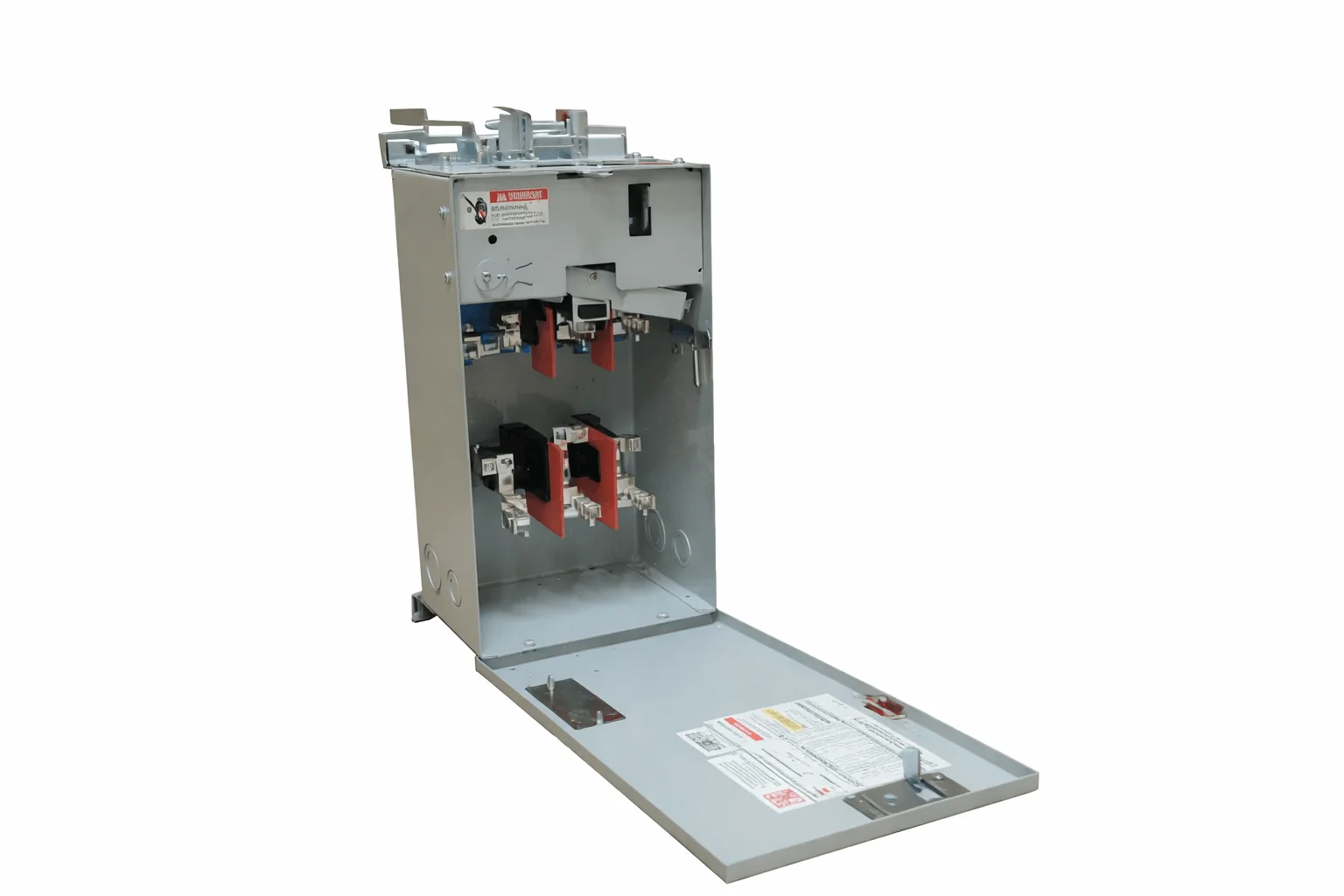
TLDR - Quick Guide
- Identify the exact Square D bus plug catalog number
- Confirm amperage, voltage, and phase configuration
- Verify stab type and mounting orientation
- Match fuse class (for fusible units)
- Cross-reference mechanical dimensions
- Validate interrupting rating and fault capacity
- Perform installation testing before energizing
Detailed Breakdown: Substitute for Square D Bus Plug Cross Reference Process
Step 1 - Locate the Original Square D Catalog Number
The first step in any substitute for square d bus plug cross reference process is identifying the full catalog number from the existing unit.
Look for:
- Catalog number plate
- Amperage rating
- Voltage rating
- Series designation
- Manufacturing revision
Without the complete catalog number, cross-referencing becomes guesswork. Even minor series differences can impact compatibility.
If the label is worn or missing, review panel documentation, single-line diagrams, or historical purchase records.
Step 2 - Confirm Electrical Specifications
Electrical compatibility is non-negotiable. The replacement must match the system’s operational requirements exactly.
Verify:
- Rated amperage (e.g., 30A, 60A, 100A, 200A)
- System voltage (typically 240V, 480V, or 600V)
- Number of poles
- Short-circuit current rating
- Frequency (50/60 Hz)
Installing a substitute bus plug with incorrect voltage or interrupting capacity can compromise system protection and create safety hazards.
Accurate specification matching is the foundation of a reliable substitute for square d bus plug cross reference.
Step 3 - Determine Fusible vs Non-Fusible Configuration
Square D bus plugs are available in both fusible and non-fusible designs. This distinction significantly impacts replacement selection.
Confirm whether the existing unit:
- Contains internal fuse holders
- Uses specific fuse classes (such as Class R or Class J)
- Functions strictly as a disconnect switch
A fusible bus plug cannot simply be replaced with a non-fusible version unless upstream protection is redesigned. Matching the original protection scheme ensures safe coordination within the distribution system.
Step 4 - Verify Stab Type and Busway Compatibility
One of the most overlooked substitutes for square d bus plug cross reference steps is verifying stab configuration.
Check:
- Busway series compatibility
- Stab orientation
- Contact blade thickness
- Insulation type
- Plug-in versus bolt-on configuration
Even if amperage and voltage match, incompatible stab geometry can prevent proper connection to the busway system. Mechanical precision is critical for reliable current transfer and safe engagement.
Step 5 - Measure Physical Dimensions and Mounting Orientation
Replacement units must physically fit within the busway housing and enclosure space.
Measure:
- Height and width
- Depth clearance
- Door swing space
- Mounting bracket alignment
Failure to confirm mechanical fit may require costly modifications or delay installation. Proper cross reference techniques ensure a seamless physical integration.
Step 6 - Evaluate Interrupting Rating and Fault Capacity
A proper substitute for square d bus plug cross reference must account for fault current levels in the facility.
Confirm:
- Available fault current at installation point
- Busway short-circuit rating
- Fuse interrupting rating (for fusible models)
If the substitute unit does not meet or exceed the system’s fault rating, it may fail during a high-current event. Protection capacity must never be downgraded during replacement.
Step 7 - Review Selective Coordination
Power distribution systems rely on coordinated protection to isolate faults without affecting the entire facility.
Ensure that the replacement bus plug:
- Matches time-current characteristics
- Aligns with upstream breaker curves
- Maintains selective coordination
Proper coordination prevents nuisance shutdowns and limits downtime during fault events.
Step 8 - Conduct Installation and Testing
After selecting the correct substitute, installation should follow strict safety protocols.
Testing should include:
- Visual inspection of stab engagement
- Mechanical latching verification
- Continuity testing
- Energization under controlled conditions
- Thermal monitoring under load
Testing confirms that the substitute for square d bus plug cross reference process was performed accurately and ensures safe operation before returning to full production.
Common Cross Reference Mistakes to Avoid
Avoid these errors when searching for a replacement:
- Matching amperage but ignoring busway series
- Overlooking fuse class compatibility
- Ignoring physical enclosure dimensions
- Downgrading interrupting rating
- Failing to review system fault current
These mistakes can result in improper fit, unsafe operation, or repeated maintenance issues.
Key Takeaways
- A proper substitute for square d bus plug cross reference begins with the full catalog number
- Electrical ratings must match exactly, including amperage and voltage
- Fusible vs non-fusible configuration significantly impacts compatibility
- Mechanical stab type and mounting orientation are critical
- Interrupting rating and selective coordination must be preserved
- Thorough testing confirms safe and reliable integration
FAQs
1. Can I replace a Square D bus plug with a different brand?
Yes, but only if all electrical and mechanical specifications match. Proper cross-referencing ensures compatibility with the busway system. Never assume physical similarity equals safe operation.
2. What happens if I choose the wrong stab configuration?
Incorrect stab geometry can prevent proper engagement with the busway. This may result in loose connections, overheating, or failure. Always verify busway series compatibility.
3. Do I need to match the exact fuse class in a fusible bus plug?
Yes, fuse class compatibility affects fault interruption and coordination. Using the wrong fuse class can compromise system protection. Always confirm fuse specifications before replacement
4. Is interrupting rating really that important?
Absolutely. The interrupting rating must meet or exceed available fault current. Underrated equipment may fail during a short-circuit event.
5. How can I speed up the substitute for square d bus plug cross reference process?
Maintain detailed equipment records and single-line diagrams. Document busway series and fault current calculations. Having accurate system information makes cross-referencing faster and more reliable.


